Meta Ads Creative Fatigue: How to Detect It Early and What to Do About It

What Creative Fatigue Actually Looks Like in the Data
Most media buyers know what creative fatigue feels like. Your campaign was printing money last week, and now it's barely breaking even. The natural reaction is to panic, check targeting, review bids, and maybe blame the algorithm. But 9 times out of 10, the answer is staring you right in the face. Your audience has seen your ads too many times, and they've stopped caring.
The problem is that most people don't have a system for detecting fatigue early. They notice it after the damage is already done, when CPAs have already spiked and ROAS has tanked. By the time you react manually, you've already wasted days of budget on a creative that stopped working.
So let's talk about what fatigue actually looks like in the data, because it's not always obvious.
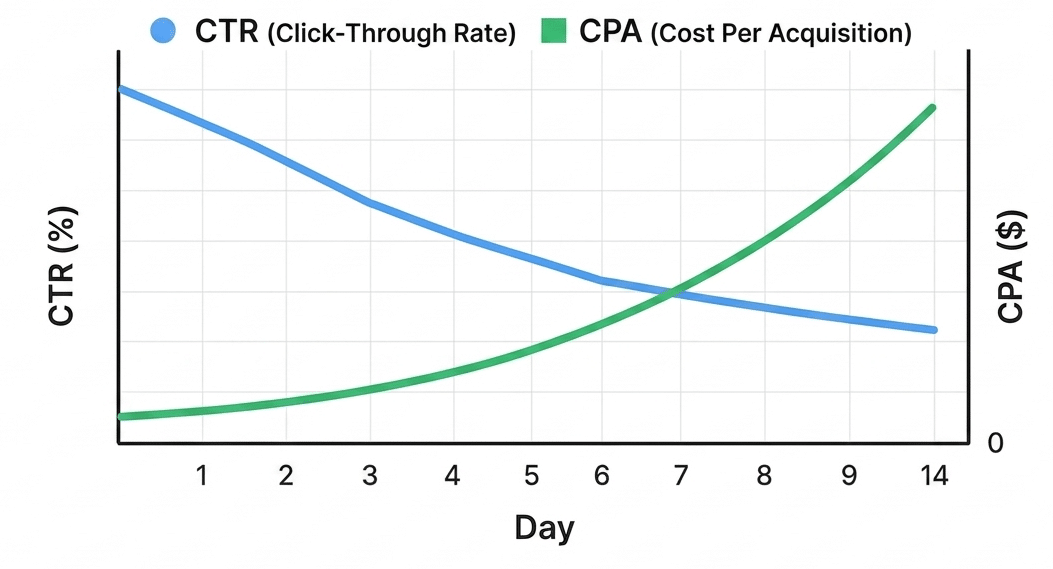
Creative fatigue doesn't happen overnight. It follows a predictable pattern:
- Days 1 to 5: Strong CTR, good CPA, healthy ROAS. The creative is fresh and the algorithm is actively finding the best audiences for it.
- Days 5 to 10: CTR starts to decline gradually. CPA may hold steady because the algorithm compensates by bidding higher or shifting delivery. You might not even notice yet.
- Days 10 to 20: CTR drops more noticeably. Frequency climbs. CPA starts creeping up. ROAS begins to slide.
- Day 20+: Performance drops significantly. The ad is now competing against itself because Meta keeps showing it to people who've already seen it multiple times. CPA is well above target.
The key insight here is that fatigue starts showing in CTR days before it shows in CPA. If you only monitor CPA, you're always reacting too late.
The Metrics That Matter
Not all metrics are equally useful for detecting fatigue. Here's what to actually watch.
CTR (Click-Through Rate): This is your early warning signal. When the same audience sees your ad repeatedly, they stop clicking. A declining CTR on an ad that was previously performing well is the first sign of fatigue. Don't confuse a naturally low CTR (which might mean the creative wasn't good to begin with) with a declining CTR (which means it was good and is losing steam).
Frequency: This tells you how many times the average person has seen your ad. For prospecting campaigns, anything above 2.5 to 3 should raise a flag. For retargeting, you can tolerate higher frequency (4 to 6) before fatigue kicks in. But even retargeting has a ceiling.
CPM (Cost Per 1,000 Impressions): When your ad loses relevance, Meta charges you more to show it. Rising CPM alongside declining CTR is a strong fatigue signal. You're paying more to reach people who are less likely to engage.
CPA / ROAS Trend: These are lagging indicators. By the time CPA spikes and ROAS drops, the fatigue has been building for days. Use these to confirm what CTR and frequency already told you, not as your primary detection method.
The formula:
If CTR is declining + Frequency is rising + CPM is increasing = creative fatigue. Don't wait for CPA to confirm it.
How to Detect Creative Fatigue Before Performance Collapses
The manual approach is to check each ad's CTR trend daily, compare it to its historical average, cross-reference with frequency, and make a judgment call. This works if you're managing 5 to 10 ads. It falls apart when you're managing 50 to 200.
Here's the data-driven approach I use:
Step 1: Establish baselines. For each ad, record its CTR during the first 3 to 5 days (the "fresh" period). This becomes the baseline. Every ad has a different natural CTR, so you need individual baselines, not account-level averages.
Step 2: Monitor the delta. Compare each ad's current 3-day CTR against its baseline. When the current CTR drops 20 to 30% below the baseline, the ad is entering the fatigue zone.
Step 3: Cross-reference with frequency. An ad with declining CTR and frequency above 3 is almost certainly fatiguing. An ad with declining CTR but frequency below 2 might have a different issue (seasonality, audience saturation from other campaigns, etc.).
Step 4: Act before the cliff. The "cliff" is when performance drops rapidly rather than gradually. If you can pause or rotate the creative before it hits the cliff, you save the ad's remaining value and protect your campaign's overall performance.
This matters even more in 2026 because of how Meta's Andromeda algorithm distributes creative delivery. Andromeda evaluates far more ads per auction, which means fatigued creatives get replaced faster in the ranking. But it also means that if all your creatives are fatiguing at the same time, your campaign has nothing to fall back on.
Setting Up Automated Fatigue Alerts
Doing the above process manually is fine for learning the patterns. But once you understand what to look for, you should automate it.
Here's the rule I use in TheOptimizer.
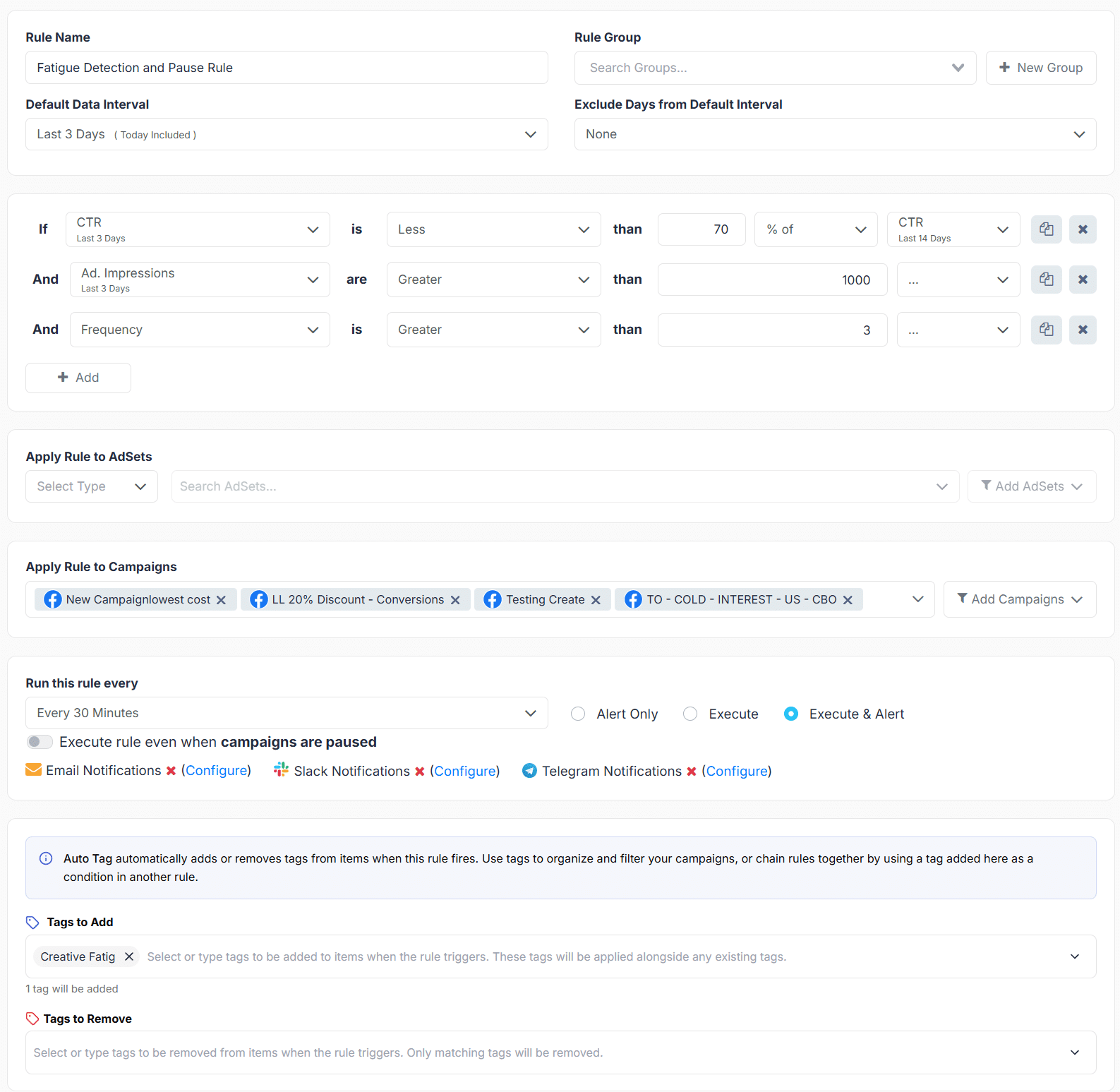
Fatigue Detection and Pause Rule:
Automation Rule Example:
IF Ad CTR over the last 3 days has decreased by 30%+ compared to its 14-day average
AND Ad Impressions over the last 3 days > 1,000
AND Ad Frequency > 3
THEN Pause the Ad AND Send a notification (email, Slack, or Telegram)
Fatigue Warning Rule (alert only, no action):
Automation Rule Example:
IF Ad CTR over the last 3 days has decreased by 15–25% compared to its 14-day average
AND Ad Frequency > 2
THEN Send alert notification
The warning rule gives you a heads-up that a creative is entering the danger zone. The action rule actually pauses it when it crosses the threshold. Having both ensures you're never caught off guard.
What to Do When Creative Fatigue Hits
Once fatigue is detected, you have a few options. The right choice depends on the situation.
Option 1: Pause and replace. The most common approach. Pause the fatigued creative and launch a new one. This works well when you have a pipeline of tested creatives ready to go.
Option 2: Rotate to a different audience. Sometimes the creative isn't dead, it's just exhausted within a specific audience segment. Moving it to a different Lookalike or interest group can give it a second life. This is more relevant for retargeting where audiences are smaller.
Option 3: Refresh the creative. Take the winning concept and create a variation. Change the hook, the opening frame, the thumbnail, or the format (turn a static into a video, turn a video into a carousel). The angle stays the same, but the visual execution is fresh enough to reset the fatigue clock.
Option 4: Pivot the angle entirely. If you've exhausted all visual variations of a winning angle, it's time to test a completely different narrative. Our guide on creating 10 different angles for the same offer walks through a framework for this.
What NOT to do: Don't just increase the budget hoping the algorithm will find new people. If the creative is fatiguing, throwing more money at it accelerates the problem, it doesn't solve it.
The Creative Rotation Strategy That Keeps Campaigns Alive
The best defense against creative fatigue is not reacting to it. It's preventing it from crippling your campaigns in the first place.
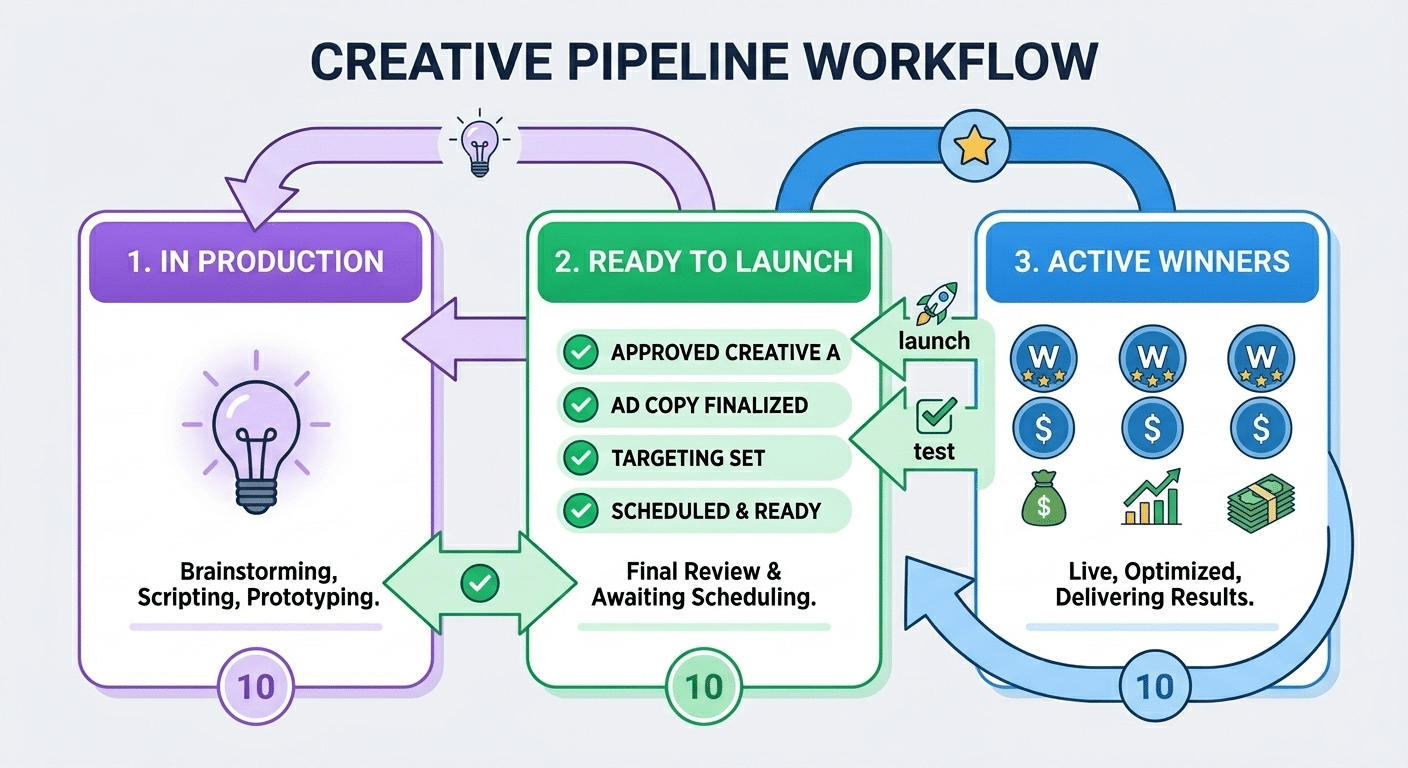
Always have 3 stages of creatives:
- Active winners (currently running and performing well): 4 to 8 creatives
- Ready to launch (tested and approved, waiting on the bench): 4 to 6 creatives
- In production (being designed or filmed right now): 4 to 6 creatives
When a winner fatigues and gets paused by your automation rules, a "ready to launch" creative immediately takes its place. Meanwhile, your team is working on the next batch.This creates a continuous pipeline where you're never scrambling to replace a dead creative. The system feeds itself.
Rotation timing:For most campaigns, plan to introduce 2 to 4 new creatives per week. At $200 to $500/day spend, a strong creative typically lasts 10 to 20 days before showing fatigue. At higher spend levels ($1,000+/day), that window shrinks to 7 to 14 days because frequency builds faster.
Your campaign structure should support this rotation. Having a dedicated testing campaign (ABO) separate from your scaling campaign (CBO) ensures that new creatives get a fair shot without competing against your current winners for budget.
Building a Sustainable Creative Pipeline
Creative fatigue is a production problem disguised as a media buying problem. If your team can't produce enough diverse creatives fast enough, no amount of automation will save you.
Diversify across three dimensions:
- Angle (the core message or emotional appeal)
- Format (static image, short video, long video, carousel, UGC)
- Length (7-second hook, 15-second spot, 30 to 60 second narrative)
Most media buyers produce 10 variations of the same angle in the same format. That's not diversity, that's volume. The algorithm treats them as essentially the same creative.Real diversity means having a testimonial video, a problem-agitation static, a data-driven carousel, and a founder-story narrative all running at the same time. Each one reaches a different subset of your audience and fatigues on a different timeline.This approach also plays directly into how Meta's Andromeda algorithm works. Andromeda can evaluate far more creative variants per auction than the old system, so giving it conceptually diverse creatives lets it find the right match for each user segment.
Recommended production cadence:
These numbers aren't arbitrary. They're based on the average creative lifespan at each spend level and the rotation needed to maintain consistent performance.
FAQ
How quickly does creative fatigue happen on Meta Ads?
It depends on your daily budget and audience size. At $100 to $200/day targeting a broad audience, a strong creative can last 2 to 3 weeks. At $1,000+/day, fatigue can set in within 7 to 10 days. Smaller audiences (retargeting) fatigue much faster, sometimes within 3 to 5 days.
Is creative fatigue the same as ad fatigue?
They're often used interchangeably, but there's a subtle difference. Creative fatigue refers specifically to the visual/messaging elements losing their impact. Ad fatigue can also include audience exhaustion (where the audience itself is saturated) even with fresh creatives. Both lead to declining performance, but they require different solutions.
Can I use the same creative on different platforms without fatigue issues?
Yes. Fatigue is platform-specific. An ad that's fatiguing on Facebook might still be fresh on Instagram, or on TikTok. However, if your targeting overlaps significantly across placements, you may see cross-platform fatigue, especially with Advantage+ placements enabled.
Should I pause a fatiguing creative or just reduce its budget?
In most cases, pausing is better. A fatiguing creative with a reduced budget will just fatigue slower while continuing to deliver poor results. Better to cut it clean and allocate the budget to a fresh creative that can deliver strong performance.
How do I know if poor performance is fatigue or just a bad creative?
Look at the trend. A creative that performed well and then declined over time is fatiguing. A creative that never performed well was just a poor creative from the start. The distinction matters because fatiguing creatives give you useful data about what worked (before it stopped working), while bad creatives just need to be killed.