Vertical vs. Horizontal Scaling on Meta Ads: When to Use Each and How to Automate Both

There are really only two ways to scale a profitable Meta campaign. You either push more money through it (vertical scaling), or you create copies of it and let each copy find its own optimization path (horizontal scaling).
Both work. Both have risks. And most media buyers rely too heavily on one while ignoring the other.
The media buyers who scale to six and seven figures per month typically use both strategies together, applying each at the right time based on the data. In this guide, I'll break down exactly when to use each approach, the specific numbers and thresholds that work, and how to automate the entire process so it runs without you watching Ads Manager all day.
Vertical Scaling: Increasing Budgets on Winners
Vertical scaling is the obvious move. You have a campaign that's profitable at $100/day, so you want to run it at $500/day. Simple in theory. Dangerous in practice.
The problem is that Meta's algorithm is sensitive to budget changes. When you increase the budget, the algorithm needs to recalibrate how it spends that money. If the increase is too aggressive, it can reset the learning phase and your carefully optimized delivery goes out the window. Your CPA spikes, ROAS drops, and you're left wondering what happened.
But vertical scaling absolutely works if you do it right. The key is gradual, data-backed increases at the right time.
The safe approach:
- Increase the daily budget by 15% to 30% at a time
- Never more than 2 times per week
- Only when the campaign has demonstrated stable performance over at least 3 days
- Always check that you have enough conversion volume to justify the increase
I go deeper into the specifics of safe budget increases in our guide to scaling Meta Ads without killing performance. But the core idea is simple: respect the algorithm's learning process and scale incrementally.
The Budget Increase Rules That Won't Reset Learning Phase
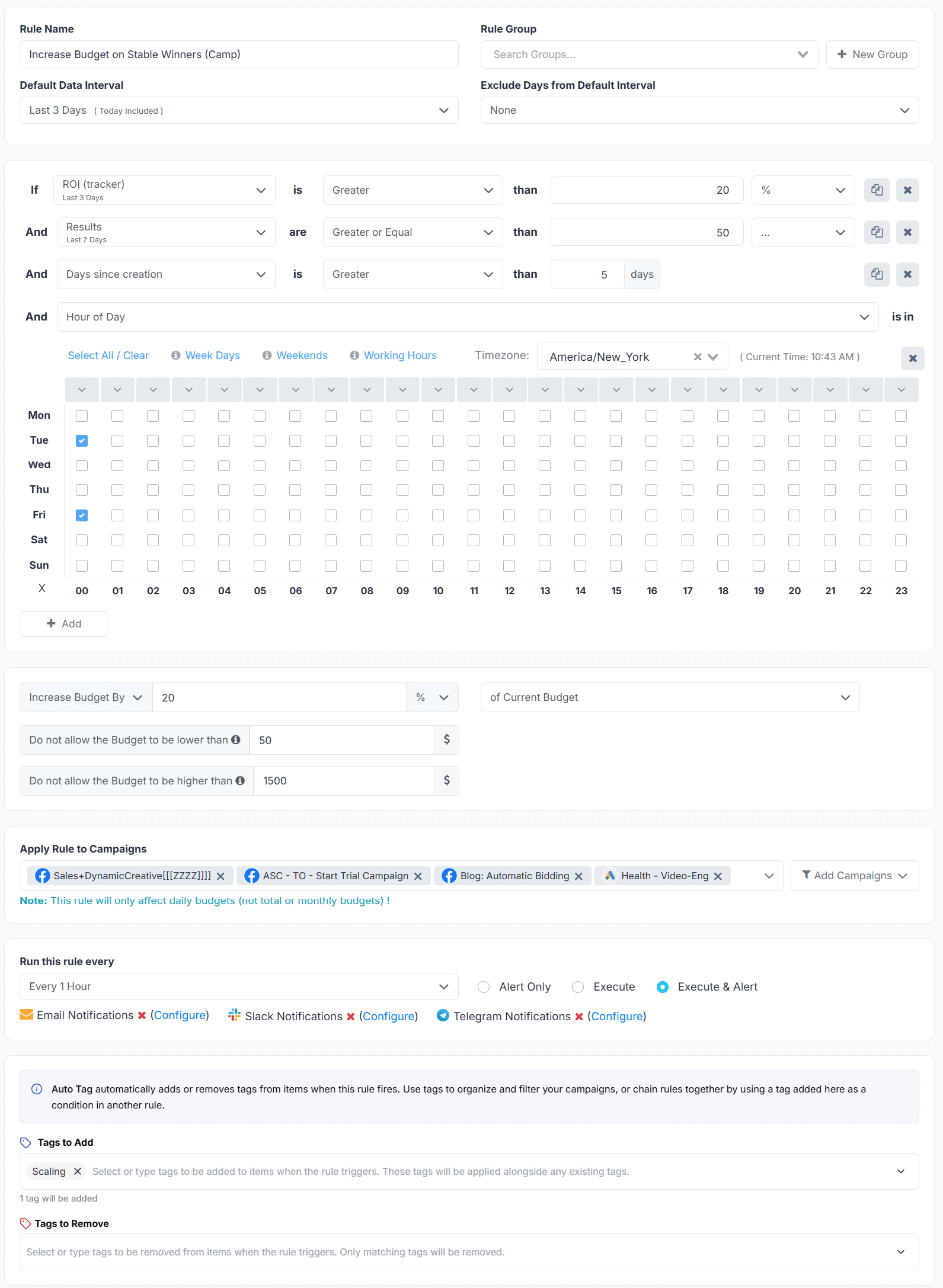
Here's the exact rule logic I use for automated vertical scaling.Rule: Increase Budget on Stable Winners
Automation Rule Example:
IF Campaign ROI over the last 3 days > X% (your profitability threshold)
AND Conversions over the last 7 days ≥ Y (minimum statistical significance)
AND Campaign has been running for 5+ days
THEN Increase daily budget by 20 to 30%
Execute maximum 2 times per week
There are a few details that make a significant difference in how this plays out.
Timing of budget changes.
This matters more than most people realize. When TheOptimizer changes the budget, it does it at the beginning of the day according to the ad account's time zone. Not at a random hour. This way Meta starts the new day with a clear budget for the rest of the day, instead of trying to spend a suddenly larger budget in the remaining hours. That difference in timing alone can prevent the algorithm from making erratic delivery decisions.
Frequency cap.
The rule runs only 2 times per week maximum. This prevents what I call the "greed scale," where you keep bumping budgets every day because the numbers look good. The algorithm needs at least 2 to 3 days between changes to stabilize. Pushing faster than that is how you ruin winners.
Data requirements.
Having a 200% ROI on 2 conversions doesn't mean you should scale. You need enough conversion volume to trust the data. As I covered in why killing campaigns too early hurts performance, the difference between bad performance and insufficient data is critical. The same principle applies to scaling. Don't scale on insufficient data.
Horizontal Scaling: Cloning Campaigns Across Accounts
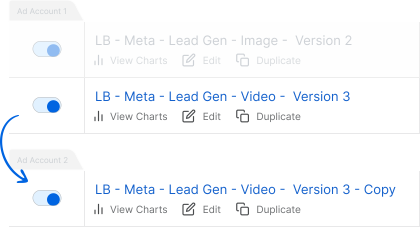
Horizontal scaling means duplicating your winning campaigns and running the copies alongside the original. You can clone within the same ad account, across different ad accounts, or even across different Business Managers.
This is the scaling strategy that most beginners overlook and most experts swear by.
Why does it work? Because each cloned campaign gets its own optimization path. Meta's algorithm treats each campaign independently, so a clone might find different audience segments or delivery patterns that the original didn't. You're essentially giving the algorithm multiple chances to optimize the same winning creative.
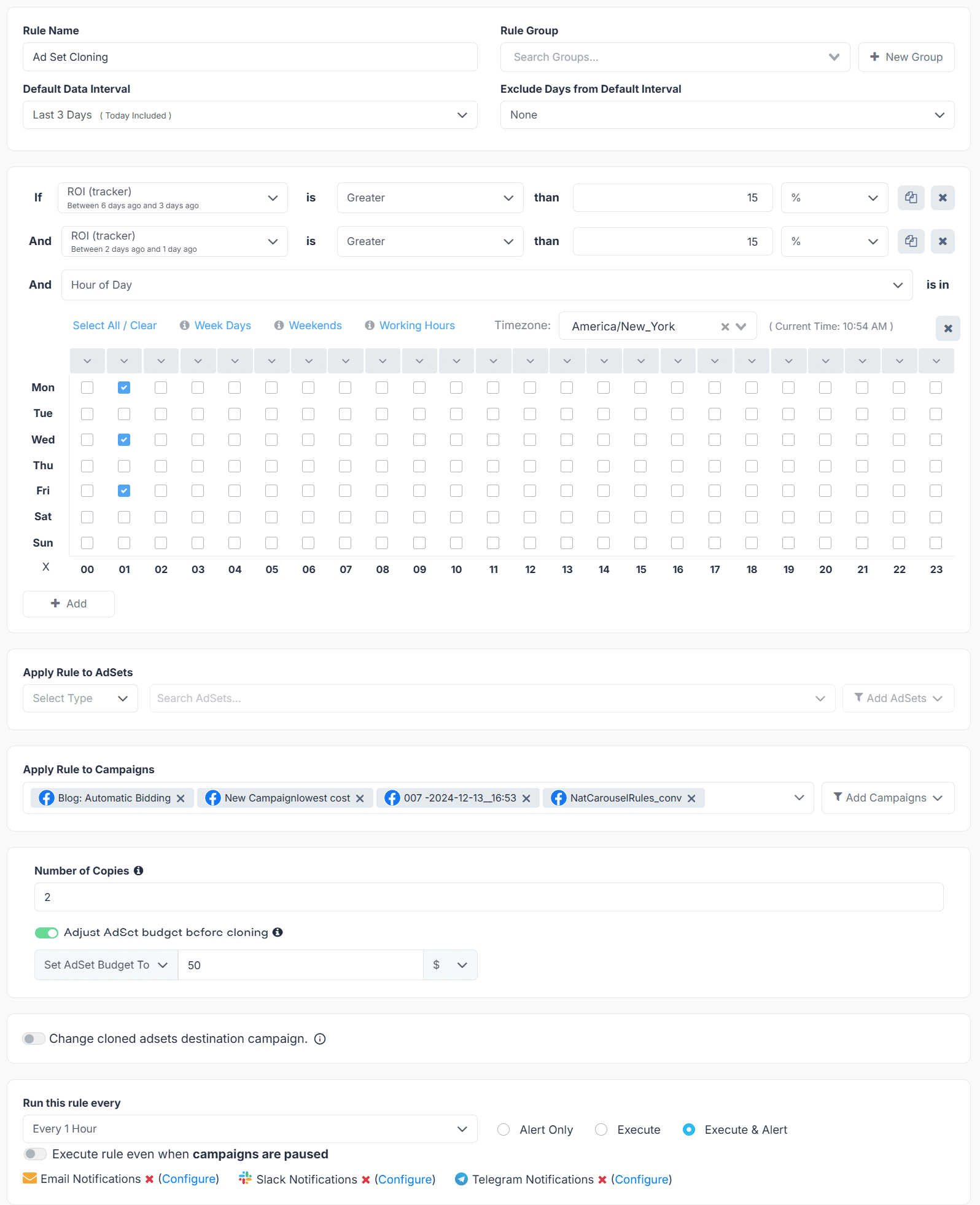
The rule I use for automated horizontal cloning:
Automation Rule Examples:
IF Ad Set ROI over the last 6 to 3 days > 15%
AND Ad Set ROI over the last 2 to 1 days > 15%
THEN Clone the Ad Set 2 times
Execute 3 times per week at 1 AM (ad account time zone)
The rule evaluates performance over two time intervals. The last 6 to 3 days gives a broader view, while the last 2 to 1 days confirms the trend is still holding. Only when both windows show profitable performance does the cloning trigger.
Cross-account cloning: TheOptimizer can also clone winning campaigns to different ad accounts automatically. This is particularly useful for advertisers managing multiple Business Managers or running high-volume operations where spreading risk across accounts makes sense.
Why horizontal scaling is often safer than vertical:
Unlike increasing budgets (which asks Meta to spend more money through a single campaign), cloning creates independent campaigns that each start with their own fresh learning. There's no risk of resetting the learning phase on your original campaign, and each clone gets a clean start.
One extra thing worth mentioning: it rarely happens that two or more identical campaigns end up competing with each other. You would need 50+ identical campaigns to risk meaningful auction overlap. So don't worry about self-competition at reasonable clone volumes.
When to Clone Campaigns vs. Ad Sets
This is a question I get a lot, so let's clear it up.
Clone at the ad set level when you want to keep the winning creative in the same campaign structure but give it more delivery opportunities. This is good for testing whether the same creative performs better with a fresh ad set that gets its own learning phase.
Clone at the campaign level when you want to test the same setup with a completely fresh budget allocation. This gives the algorithm maximum freedom to optimize without interference from other ad sets in the original campaign.
Clone across ad accounts when you're spending serious money and want to distribute risk. Different ad accounts can have different optimization histories, and a winning campaign might perform differently (sometimes better) in a fresh account.
My recommendation: start with ad set cloning within the same campaign. If that works, graduate to campaign-level cloning. Once you're spending $50K+/month, add cross-account cloning to your toolkit.
When to Use Vertical vs. Horizontal Scaling
Here's a practical framework:
The right approach also depends on your campaign structure. CBO campaigns are generally easier to scale vertically because the algorithm handles budget distribution. ABO campaigns benefit more from horizontal scaling because each ad set has its own fixed budget.
Automating Both Scaling Strategies
The real power comes when both strategies run simultaneously on autopilot. Here's how I set it up.
Vertical scaling automation (Rule A):
- Checks winning campaigns twice a week
- Increases budget by 20 to 30% if performance is stable
- Never allows budget to go above a maximum ceiling you define
- Changes happen at the start of the day in the ad account's time zone
Horizontal scaling automation (Rule B):
- Detects winning ad sets based on performance across two time windows
- Clones them 2 times, 3 times per week
- Optionally clones to different ad accounts
- Resets daily budget on clones to avoid starting with inflated spend
Budget protection automation (Rule C):
- Decreases budget by 20% if CPA has increased 30%+ over the last 3 days
- Pauses campaigns entirely if ROI drops below -30% after 3 full days
- Sends alerts when performance dips below thresholds
Together, these rules create a self-regulating system. Budgets go up when things are working, campaigns get cloned when they prove themselves, and everything gets pulled back when performance declines. For the full list of rules I use, check out 8 automation rules top media buyers use to scale Meta Ads safely.
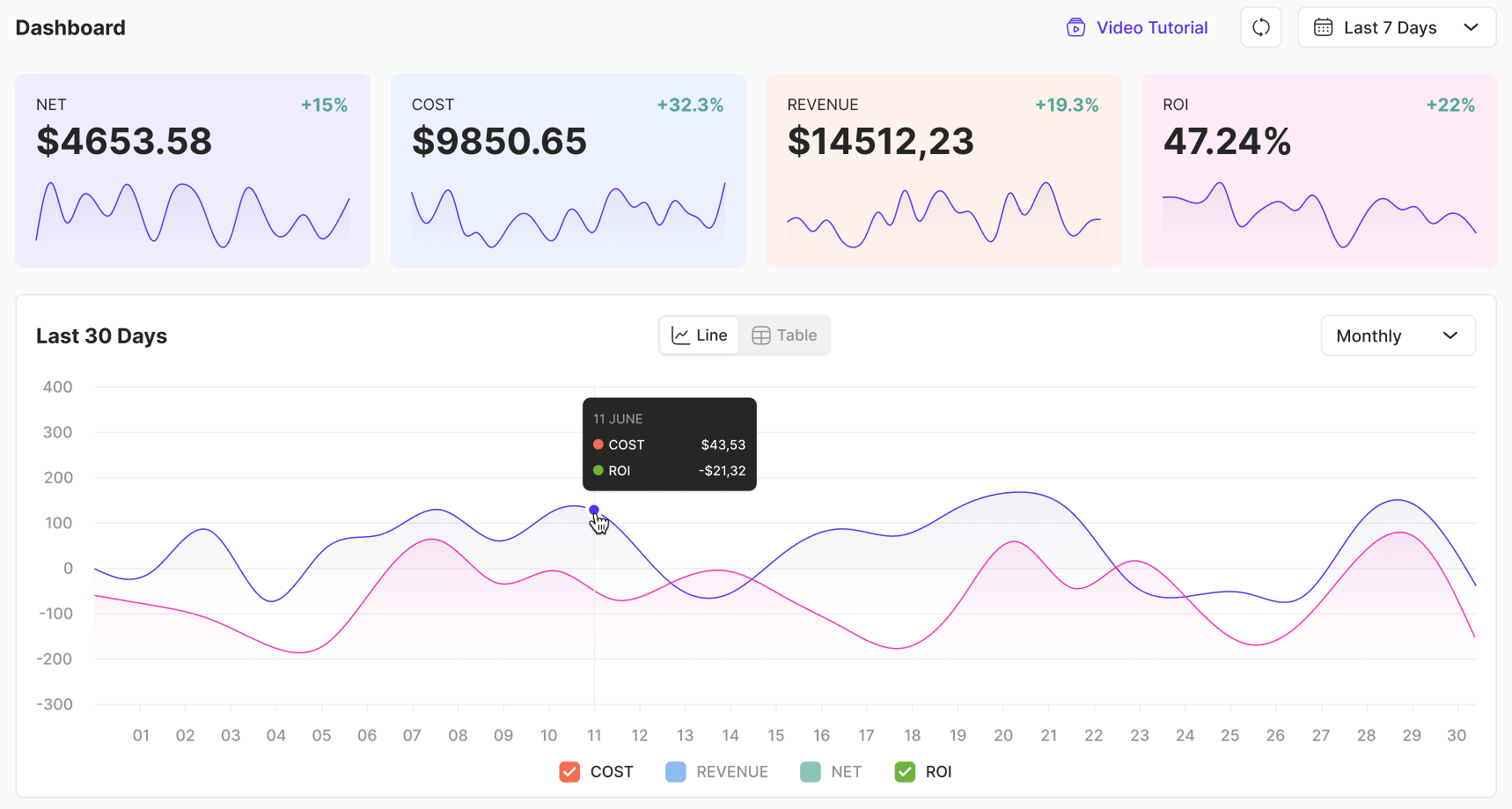
All of this runs inside TheOptimizer, which executes rules every 10 minutes across unlimited ad accounts. You check in once or twice a day to review what happened, and the system handles the rest.
Common Scaling Mistakes That Kill Profitable Campaigns
Before I wrap up, let me cover the most common scaling mistakes I see:
1. Doubling or tripling the budget overnight. This is the number one campaign killer. Going from $100/day to $300/day in one move almost always triggers a learning phase reset. Stick to 15 to 30% increases.
2. Scaling too early. Just because you see a good CPA within the first couple of days doesn't mean the campaign is ready to scale. You need at least 5 to 7 days of stable performance with enough conversion volume before making scaling decisions.
Check out: “Why Killing Campaigns Too Early Hurts Performance”
3. Scaling only vertically. Many media buyers never try horizontal scaling. They just keep pushing more money through a single campaign until it breaks. Adding clones distributes the load and gives you multiple shots at finding optimal delivery.
4. Not having stop-loss rules alongside scaling rules. Scaling without protection is gambling. You need both systems working together so that if a scaled campaign starts losing money, it gets pulled back automatically.
5. Manual scaling with inconsistent timing. If you scale budgets whenever you happen to check Ads Manager (sometimes morning, sometimes evening, sometimes not at all), you're introducing randomness that the algorithm can't predict. Automated rules ensure changes happen at consistent, optimal times.
FAQ
What's the maximum budget increase I can make without resetting the learning phase?
Meta doesn't publish an exact threshold, but based on extensive testing, 20 to 30% per change is the sweet spot. Anything above 50% significantly increases the risk of triggering a learning phase reset.
How many clones should I run at the same time?
For most campaigns, 3 to 5 active clones plus the original is a good range. At very high spend levels ($50K+/month), I've seen advertisers run 10 to 20 clones across multiple ad accounts without competition issues.
Should I change anything on the cloned campaigns?
Generally, no. The point of horizontal scaling is to test the same winning setup with a fresh optimization path. If you start changing variables, you're no longer scaling. You're testing. Keep clones identical, at least initially.
Can I combine horizontal scaling with different audience targeting?
Yes, and this is actually a smart advanced strategy. Clone the winning campaign but change the targeting (different Lookalike %, different interest groups). This is technically a hybrid of scaling and testing, but it can uncover profitable audience segments you wouldn't have found otherwise.
How do I know if my cloned campaigns are competing with each other?
Watch your CPMs. If CPMs across all clones start rising without an increase in overall market competition, your campaigns might be entering the same auctions. This is rare at moderate clone volumes (under 10), but worth monitoring at higher volumes.