
Meta Ads Value Rules: How They Work, When They Help, and When They'll Drain Your Budget

For the past two years, Meta has been stripping away manual controls. Interest targeting became a "suggestion." Detailed targeting expanded by default. Advantage+ took over audience selection. The message was clear: trust the algorithm.
Then, in June 2025, Meta did something that seemed to contradict all of that. They gave advertisers value rules.
Value rules let you tell Meta's algorithm that certain audience segments are worth more (or less) to your business, and to adjust its bids accordingly. You can bid 60% more for women aged 25 to 34. Or bid 40% less for users in a specific country. Or deprioritize a placement where your conversions have a high refund rate. All without creating separate ad sets or fragmenting your campaign structure.
As Jon Loomer put it in his deep dive on the feature: value rules address a real weakness in Meta's optimization. The algorithm is designed to get you the most results possible. But it doesn't inherently care about the value of those results. It optimizes for volume, not quality. Value rules let you layer business intelligence on top of algorithmic efficiency.
The feature launched for Sales and App Promotion campaigns in June 2025, expanded to all campaign objectives by August 2025, and received significant enhancements in 2026 including placement-specific rules and device platform adjustments.
But here's the thing Meta tells you upfront in the setup screen: "When you use value rules, you may see more conversions from your preferred audiences, but your overall cost per result may increase."
That warning isn't decoration. Meta's own documentation says value rules can increase your cost per result by 20 to 1,000%. Not a typo. One thousand percent.
So the question isn't whether value rules are powerful. They are. The question is whether you know enough about your business data to use them without lighting money on fire.
How Value Rules Actually Work (With Examples)
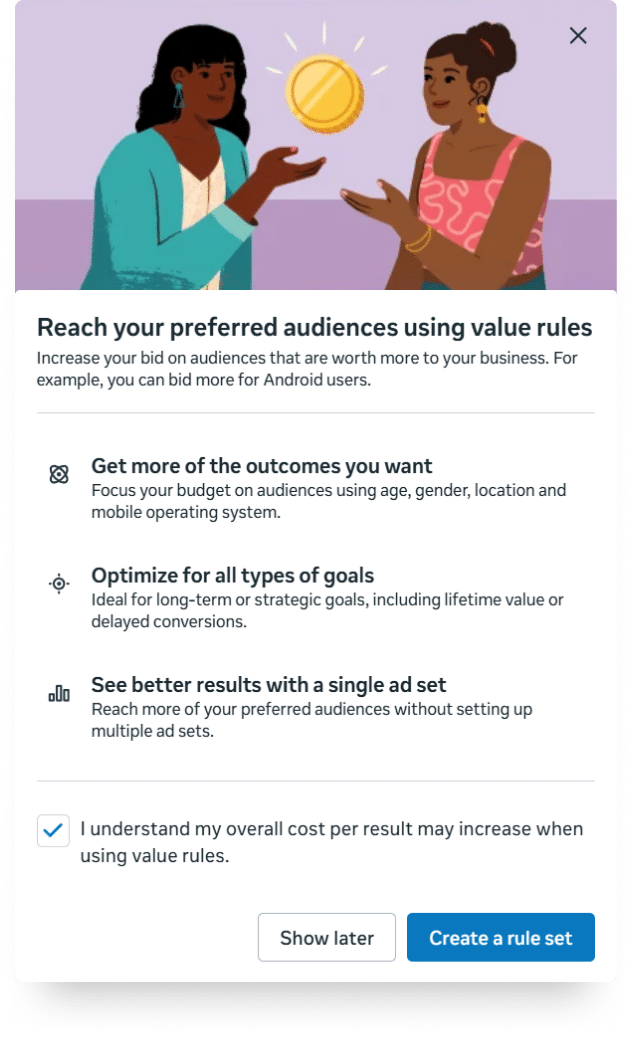
The logic is straightforward. Value rules are bid multipliers applied at the audience segment level within Meta's auction system.
Every time your ad is eligible to appear, Meta calculates a Total Value Score:
Total Value = (Advertiser Bid x Estimated Action Rate) + Ad Quality + User Value
When you set a value rule, you're adjusting the "Advertiser Bid" component for specific audience segments. A +50% rule means Meta bids 50% higher for people matching that segment. A -40% rule means Meta bids 40% less.
What you can target with value rules:
- Age ranges
- GenderLocation (countries, regions, states)
- Mobile operating system (iOS or Android)
- Device platform
- Ad placement (Feed, Stories, Reels, Audience Network, Marketplace)
You can combine up to 2 criteria per rule (for example, "women aged 25 to 34" or "iOS users in California"). You can create up to 10 rules per rule set, and up to 6 rule sets per account.
Rule priority matters. When a user qualifies for multiple rules, Meta applies only the first matching rule in the sequence. So if Rule 1 is "+20% for women in California" and Rule 2 is "+50% for iOS users," a woman in California using an iOS device gets the +20%, not the +50%. Order your rules from most specific to least specific.
Example 1: E-commerce LTV optimizationYour data shows women aged 25 to 44 have an average lifetime value of $850 over 12 months. Your overall average is $530. Women in this age range are worth about 60% more to your business.
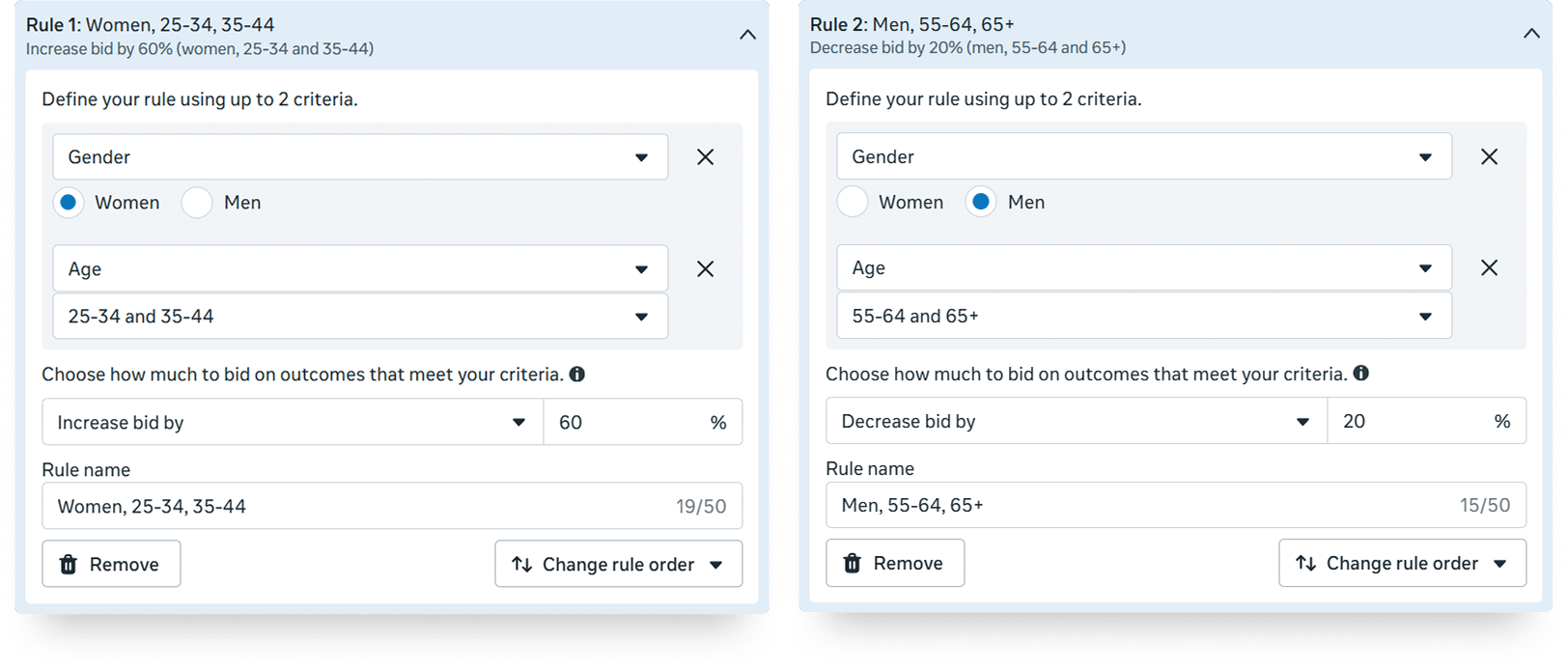
Setup:
- Rule 1: Increase bid +60% for Women, Age 25-44
- Rule 2: Decrease bid -20% for Men, Age 55-65+
Your current CPA is $45 across all demographics. With the +60% bid increase, you're willing to pay up to $72 to acquire a woman aged 25 to 44, because her LTV justifies it. Meanwhile, you're bidding less for a segment that your CRM data shows has a high return rate and low repeat purchase rate.
Example 2: Geographic performance differencesYou run a B2B SaaS product. Leads from major US metro areas convert to paid customers at 3x the rate of leads from smaller markets.
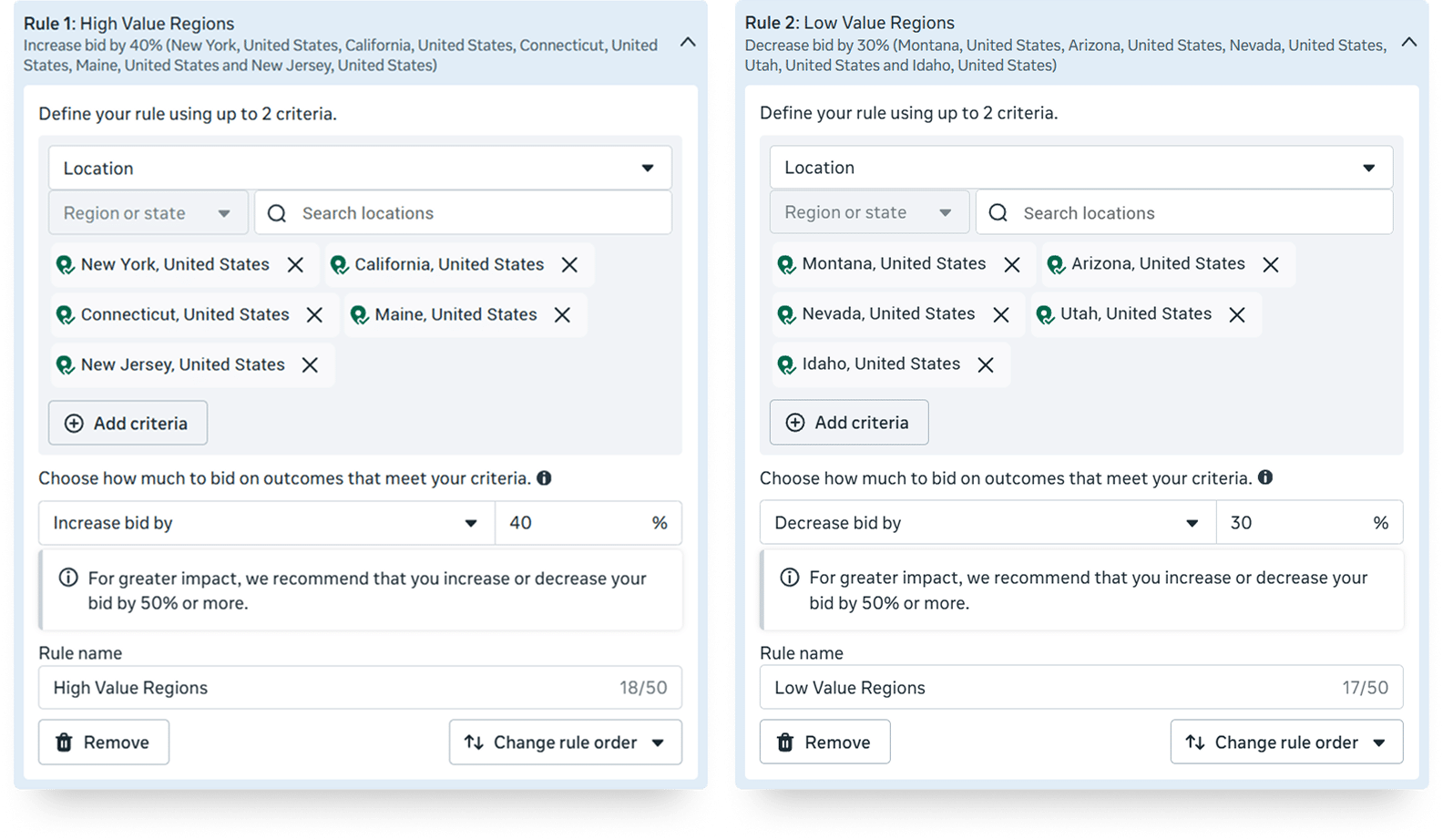
Setup:
- Rule 1: Increase bid +40% for Location: New York, San Francisco, Chicago, Los Angeles, Austin
- Rule 2: Decrease bid -30% for Location: [lower-converting regions]
Meta's algorithm still reaches all audiences. But it bids more aggressively for impressions in high-converting metros, steering more budget toward the leads that actually close.
Example 3: Placement quality differencesYour data shows that Feed conversions have 2x the average order value compared to Audience Network conversions.
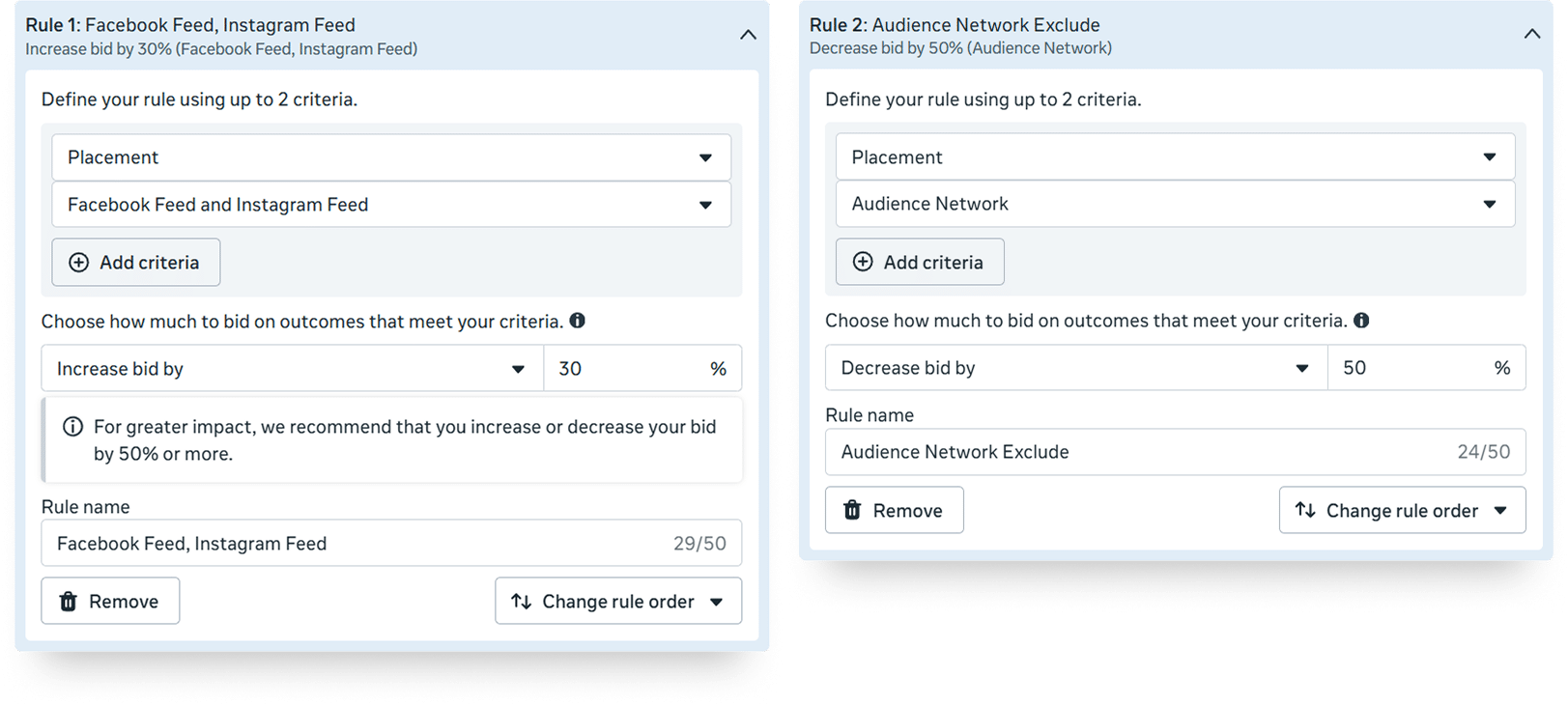
Setup:
- Rule 1: Increase bid +30% for Placement: Facebook Feed, Instagram Feed
- Rule 2: Decrease bid -50% for Placement: Audience Network
Instead of excluding Audience Network entirely (which reduces the algorithm's delivery options), you're deprioritizing it through bid adjustments. Meta will still deliver there when it's extremely cheap, but your budget concentrates on placements where the conversion quality is higher.
How Value Rules Impact Campaign Pacing and Spend
This is where things get practical and where most advertisers underestimate the effect.
Value rules don't change your daily budget setting. Your budget stays the same. What changes is how aggressively Meta competes in auctions for specific segments.
When you increase bids for a segment, Meta enters higher-priced auctions to reach those people. That means:
- You win more auctions for that segment. More of your budget goes toward the people you value most.
- You pay more per impression for that segment. Higher bids mean higher CPMs.
- Your budget depletes faster if a large portion of your audience matches the high-bid rule.
When you decrease bids for a segment, the opposite happens. Meta is less competitive in auctions for those people, which means fewer impressions but lower cost per impression.
The net effect on pacing:If your high-value segment is a small portion of your total audience (say, 15%), the pacing impact is manageable. The budget shifts toward that 15% without dramatically changing overall delivery.But if your high-value segment is 60% of your audience and you're bidding +50%, you've effectively increased your average bid across most of your delivery. Your budget will pace faster and may exhaust earlier in the day.
What to watch for:
- Check hourly delivery after activating value rules. If your budget is exhausting by 2 PM instead of running through the full day, your bid increases are too aggressive for your budget.
- Monitor impression share by segment. Are you actually getting more delivery to the segments you increased bids for? If not, competition might be too high at that bid level.
How Value Rules Impact Cost Per Result
Let me be blunt about this. Value rules will almost always increase your average cost per result. Meta tells you this outright during setup.The question isn't "will costs go up?" They will. The question is "will the value of the results go up by more than the cost?"Here's the math that matters:
Without value rules:
- 100 conversions at $45 CPA = $4,500 spend
- Average customer value: $530
- Total customer value: $53,000
- ROAS: 11.8x
With value rules (+60% bid for high-LTV segment):
- 85 total conversions at $55 CPA = $4,675 spend
- 50 of those conversions are from the high-LTV segment ($850 average value)
- 35 conversions from other segments ($530 average value)
- Total customer value: (50 x $850) + (35 x $530) = $61,050
- ROAS: 13.1x
Fewer total conversions. Higher CPA. But higher total customer value and better ROAS.
That's the trade-off. Value rules sacrifice volume efficiency for value efficiency. If you're optimizing for top-line conversion count, value rules will look like they're hurting you. If you're optimizing for revenue and LTV, they can look very different.
Value Rules vs. Narrow Audience Targeting
Before value rules existed, the standard approach for targeting high-value segments was audience fragmentation. You'd create separate ad sets for different demographics, each with its own budget. Women 25 to 34 in one ad set. Men 35 to 44 in another. Different budgets reflecting different segment values.
This approach has three problems in 2026:
1. It fragments the learning phase.Each ad set needs 50 conversion events per week to exit learning phase. If you split one campaign into 4 demographic ad sets, each one needs to generate 50 events independently. That's 200 events per week just to get all ad sets out of learning, compared to 50 events for a single consolidated ad set.
This is the same budget dilution problem we covered in our campaign structure best practices guide. Fragmentation starves the algorithm.
2. It limits Andromeda's reach.
Under Andromeda, the algorithm evaluates 10,000x more ad variants per auction than the old system. Restricting by demographics limits the pool of users Andromeda can consider. Value rules let the algorithm see everyone while bidding more for the people you care about most.
As Jon Loomer explained in his 2026 targeting guide: "When this is proven to be a problem, use value rules to adjust bids by age or gender, rather than restricting by demographic group."
3. It creates CPM penalties.Narrow audiences on Meta tend to have higher CPMs because you're competing in a smaller auction pool. Broad targeting with value rules keeps CPMs lower overall while steering delivery toward high-value segments through bid adjustments.
When narrow targeting still makes sense:
- Age-restricted products (alcohol, gambling). This is a compliance requirement, not an optimization choice.
- Location restrictions. If you can only serve customers in specific states or countries, that's a hard constraint, not a preference.
- Retargeting custom audiences. These are small, defined groups where fragmentation is the point.
For everything else, the 2026 best practice is: broad audience, diverse creatives, value rules to steer delivery.
Value Rules vs. Third-Party Optimization Tools
Here's where I want to be careful, because this comparison isn't apples to apples. Value rules and third-party automation tools like TheOptimizer solve different problems. And in practice, they work best together.
What value rules do:
Value rules operate inside the auction. They tell Meta how to bid before the impression is delivered. They influence who sees your ad and how much you pay for each impression. This happens in real-time, inside Meta's system, at the moment of the auction.
What third-party tools do:
Tools like TheOptimizer operate outside the auction. They monitor campaign performance after impressions are delivered, then take actions based on the results: pausing campaigns, adjusting budgets, detecting creative fatigue, cloning winners, alerting you to problems. This happens every 10 minutes (in TheOptimizer's case) based on confirmed performance data.
The gap value rules can't fill:
Value rules don't pause a campaign that's bleeding money at 2 AM. They don't detect that a creative's CTR dropped 30% over the last 3 days. They don't increase the budget on a winner that's been stable for a week. They don't clone a profitable campaign to a different ad account. They don't pull real revenue data from your Voluum or RedTrack tracker and use it to make optimization decisions.Value rules steer the algorithm's behavior. Third-party tools manage the campaign's lifecycle.
The gap third-party tools can't fill:
Automation tools operate at the campaign, ad set, and ad level. They can't adjust bids for a specific demographic within an ad set. They can't tell Meta to bid more for women aged 25 to 34 in California. That's inside Meta's auction system, and only value rules (or manual audience fragmentation) can influence it.
How they work together:
The best setup is both. Use value rules to steer the algorithm toward high-value segments inside the auction. Use TheOptimizer to manage everything that happens after: budget protection, scaling, fatigue detection, and performance-based automation.
Example workflow:
- Value rules tell Meta to bid +40% for your highest-LTV demographic
- TheOptimizer's stop-loss rule pauses the campaign if CPA exceeds your threshold, regardless of which segment is driving the cost
- TheOptimizer's scaling rule increases the budget when the campaign maintains stable ROI across all segments over 3+ days
- TheOptimizer's fatigue rule catches declining creative performance before it affects the segments value rules are prioritizing
- TheOptimizer's tracker integration validates whether the high-value segment is actually generating the revenue your CRM data predicted
For the full list of automation rules I use alongside value rules, check our guide on 8 automation rules for scaling Meta Ads safely.
How to Set Up and Optimize Campaigns Using Value Rules
Here's the step-by-step approach I recommend. Don't skip the data phase. Implementing value rules without data is just guessing with a bigger price tag.
Phase 1: Gather your data (1 to 2 weeks)Before touching value rules, you need to know which segments are actually more valuable. Not what you think. What the data says.Pull from your CRM or backend analytics:
- LTV by age and gender. Which demographics have the highest lifetime value?
- Conversion quality by location. Which geos produce leads that actually close?
- Revenue by device/OS. Do iOS users spend more than Android users?
- Conversion quality by placement. Do Feed conversions have higher AOV than Stories or Audience Network?
If you don't have this data, use Meta's breakdown reports (Breakdown > By Delivery > Age, Gender, Platform, Placement) as a starting proxy. But know that in-platform data only shows you Meta-attributed metrics, not true downstream value.
Phase 2: Start conservative (week 1 to 2)Many ad buyers recommend starting with 10 to 20% bid adjustments, not 50%+. The reason: you need to see how the algorithm responds before committing to aggressive bids.Start with a single criterion. Don't create 10 rules on day one. Pick the segment with the clearest data (your highest-LTV demographic, for example) and create one rule.
Phase 3: Monitor and compare (week 2 to 4)Track these metrics weekly for at least 4 weeks:
- CPA by segment (is the high-bid segment's CPA justified by its value?)
- Overall CPA (how much did aggregate costs increase?)
- Impression distribution (did delivery actually shift toward the high-value segment?)
- ROAS by segment (is the segment delivering the revenue you expected?)
Use Meta's breakdown reports plus your CRM data to validate. Don't rely on Meta's numbers alone.
Phase 4: Iterate and expandIf the first rule is working (higher ROAS from the target segment, justified CPA increase), add a second rule. Consider a bid decrease for your lowest-value segment, which often delivers better results than bid increases because you're reducing waste rather than adding cost.
Phase 5: Layer automation on topOnce your value rules are stable, add TheOptimizer rules to manage the campaign lifecycle:
- Stop-loss: Pause if overall CPA exceeds threshold (accounts for value-rule-driven cost increases)
- Budget scaling: Increase budget when blended ROAS across all segments is stable
- Creative fatigue: Detect and pause fatigued creatives that affect delivery to high-value segments
For the complete automation playbook, see our article on building a Meta Ads automation playbook from scratch.

The 6 Mistakes That Turn Value Rules Into a Money Pit
Based on what I've seen across accounts and what experts like Pleurat Breznica and Jon Loomer have documented, these are the mistakes that consistently burn money:
1. Implementing without data. Guessing which segments are more valuable is just paying more for traffic you hope will be better. Check your CRM first. If you don't have segment-level LTV data, you're not ready for value rules.
2. Starting too aggressive. Going from 0% to +100% overnight is how you blow up a CPA. One documented case showed an advertiser who started with a +100% bid increase and saw cost per acquisition jump 150% overnight with no improvement in customer quality. Start at 10 to 20%. Scale up based on results.
3. Ignoring rule priority order. When a user qualifies for multiple rules, only the first matching rule applies. If your rules are ordered wrong, your most important adjustments might never fire. Put the most specific (two-criteria) rules at the top and the broadest (single-criteria) rules at the bottom.
4. Using value rules when the campaign is already performing well. If Meta's algorithm is already finding your best customers efficiently, adding value rules just adds cost. As Jon Loomer wrote: "Do not assume that Value Rules are required. Particularly when maximizing the number of conversions where the conversion event is a purchase, the algorithm rarely wastes your money on segments that won't lead to that action."
Value rules solve specific problems. Make sure you actually have one before applying them.
5. Only increasing bids, never decreasing. Bid decreases for low-value segments often deliver better results than bid increases for high-value segments. You're reducing waste rather than adding cost. The algorithm still reaches low-value segments when it's very cheap, but stops prioritizing them.
6. Not validating with off-platform data. Meta's breakdown reports show you Meta-attributed metrics. They don't tell you whether the "high-value segment" you're bidding up is actually generating higher LTV in your CRM. Cross-reference with backend data monthly. If the real-world numbers don't support the bid adjustments, pull them back.
FAQ
What are Meta Ads value rules?
Value rules are bid multipliers that let you tell Meta's algorithm to bid more or less for specific audience segments (age, gender, location, device, placement) without creating separate ad sets. They influence how aggressively Meta competes in auctions for people matching your criteria.
Will value rules increase my costs?
Almost certainly yes. Meta warns that costs per result can increase by 20 to 1,000%. The goal isn't lower costs. It's higher value per conversion. If the LTV of the segment you're bidding up justifies the higher CPA, the net result is positive.
How many value rules can I create?
Up to 10 rules per rule set, with up to 6 rule sets per account. Each rule can combine up to 2 criteria. Rule order determines priority when a user matches multiple rules.
Should I use value rules or separate ad sets for different demographics?
Value rules in most cases. Separate ad sets fragment the learning phase and increase CPMs. Value rules let you keep one consolidated ad set (better for the algorithm) while steering delivery through bid adjustments. Separate ad sets only make sense for compliance requirements (age-restricted products) or radically different creative strategies per segment.
Do value rules work with Advantage+ campaigns?
Value rules are available across all campaign objectives including Advantage+ Sales campaigns. However, they're not yet available for Advantage+ Catalog Ads as of early 2026. This restriction is expected to be temporary.
How long should I test value rules before judging results?
At least 14 days, ideally 4 weeks. The algorithm needs time to adjust delivery patterns, and you need enough data across both the high-bid and standard-bid segments to compare meaningfully. Don't make judgment calls after 3 days.
Can value rules replace a third-party optimization tool?
No. Value rules influence Meta's bidding behavior inside the auction. Third-party tools like TheOptimizer manage campaign performance after the auction: pausing losers, scaling winners, detecting fatigue, and pulling tracker data for real ROI calculations. They solve different problems and work best together.