The Brazilian Method for Meta Ads (Escala Baiana): The Campaign Testing Structure That Breaks Every Rule

One campaign. 50 ad sets. One ad on each ad set. The same tiny budget spread evenly across all of them. You let it run for a few days, then you take the winners and duplicate them into even more ad sets.
It looks messy. It looks like exactly the kind of thing Meta's own reps would tell you not to do. In the Andromeda era, where Meta wants you to throw all your creatives into one consolidated ad set and let the algorithm sort it out, this structure looks like a throwback to 2019.
But there's a reason Brazilian direct response buyers built it, and a reason it keeps showing up in high-volume performance accounts. They weren't trying to build a clever campaign architecture. They were trying to force results out of Meta's auction. To stress-test the algorithm into finding winners fast, at the lowest possible cost, while giving every single ad a fair and equal shot.
The method is called Escala Baiana. In English, the Bahian Method or, more commonly, the Brazilian Method. In this article I'll break down how it works, why it deliberately breaks Meta's best practices, what you need to run it, and how to automate the parts that will otherwise eat your entire week.
Fair warning: the structure is simple. The execution is brutally labor intensive. That gap is where almost everyone messes it up.
What Is the Brazilian Method (Escala Baiana)?
The Brazilian Method is a Meta Ads media buying strategy that came out of Brazil's aggressive direct response and infoproduct scene. It's most closely associated with media buyer Almir Lima, whose "Método Baiano" popularized the two-stage 1-50-1 structure across Brazilian performance marketing communities.
The name breaks down like this. "Escala" means scaling. "Baiana" refers to Bahia, a state in northeastern Brazil. Put together, it's the "Bahian scaling" method. The "1-50-1" shorthand describes the testing structure: 1 campaign, 50 ad sets, 1 ad per ad set.
At its core, the method is built on three principles that run opposite to modern Meta recommendations:
Extreme fragmentation. Instead of consolidating creatives into a few ad sets, you isolate every single ad in its own ad set. Each creative gets its own container, its own budget, its own clean read.
Micro budgets. Each ad set runs on a tiny daily budget (roughly $1.35 to $1.50 per ad set, mirroring the original R$7 per ad set in Brazilian reais). You're not betting big on any single creative. You're spreading small, equal bets across 50 of them.
Ruthless, ROI-only winner selection. After a short test window, you keep only the ads that hit a defined ROI threshold (typically 200% ROI, or ROI ≥ 2). Everything else dies. No sentimentality about CTR, engagement, or "it's still learning."
The philosophy is simple: give every ad an identical, fair fight, let the market vote with actual purchases, and then pour resources into only the proven survivors.
Why It Goes Against Everything Meta Recommends
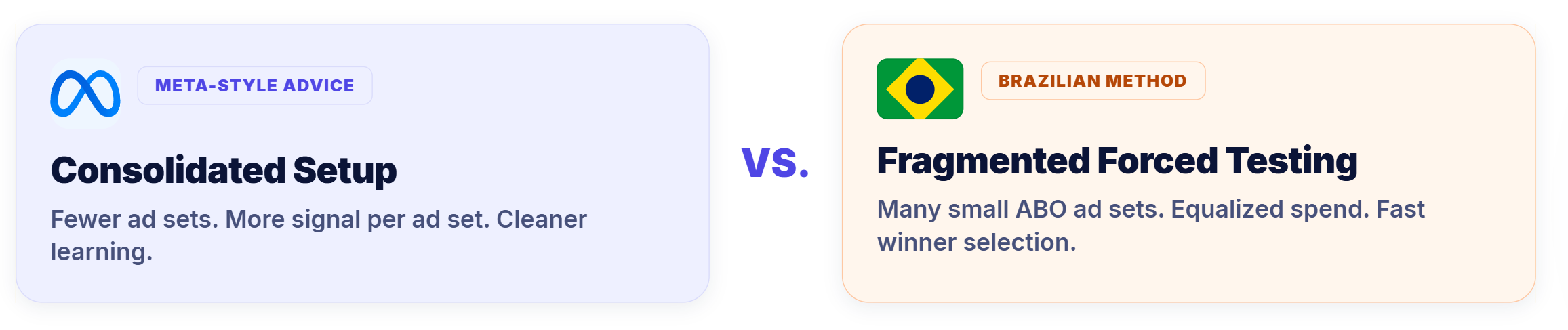
If you've read anything Meta has published in the last two years, you know the official guidance points in the exact opposite direction.
Since the Andromeda update, Meta actively recommends consolidation. Throw all your creatives into one ad set. Let Advantage+ handle placements, budgets, and delivery. Give the algorithm maximum flexibility and a large budget so it can exit the learning phase quickly. The whole modern playbook is about feeding one powerful, consolidated system.
The Brazilian Method does the reverse on every axis:
There's a real tension here. The method fragments budgets in a way that would normally trigger the budget dilution problem that keeps ad sets stuck in "Learning Limited." Each $1.35 ad set will almost never hit the 50-conversions-per-week threshold Meta wants.
So why does anyone use it? Because the goal isn't to optimize each ad set. The goal is discovery. You're not asking Meta to perfect delivery on 50 ad sets. You're asking it to quickly find which of your 50 distinct creatives can produce a profitable sale with almost no budget behind it. A creative that can generate a 200% ROI on $1.35 a day is a creative with genuinely strong product-market fit. Those are the ones worth scaling.
The fragmentation isn't the point. It's the filter.
How the Method Actually Works: Testing vs. Scaling
The Brazilian Method has two distinct phases, and they look very different from each other. Confusing the two is the fastest way to burn money.
Phase 1: Testing (the 1-50-1 structure)
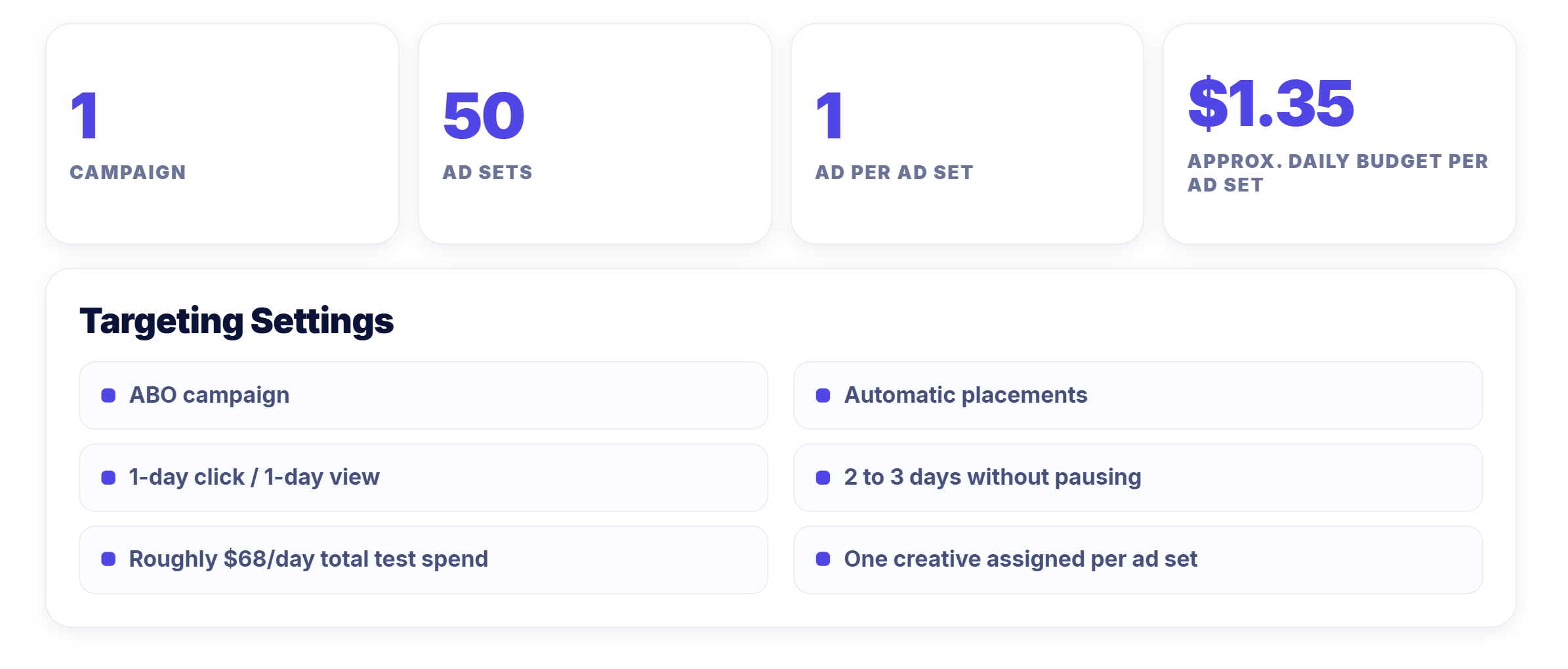
You launch one ABO campaign with 50 ad sets, one unique ad in each, equal micro budgets, and let it run for a minimum of 3 days. The only question you're answering: which of these 50 creatives hit 200% ROI or higher?
Phase 2: Scaling (relaunch winners into a bigger structure)
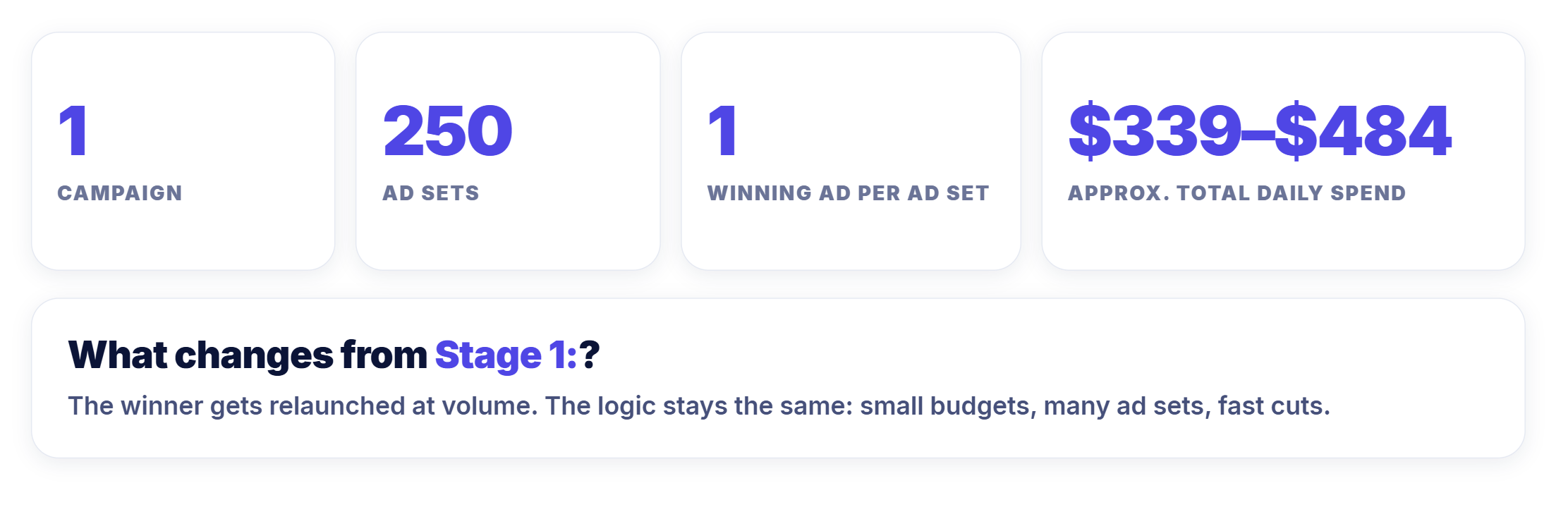
You take the winners from Phase 1 and relaunch them into a new campaign with the same overall logic, but far more ad sets. The original method pushes toward a 1-250-1 structure for scaling: one campaign, 250 ad sets built from your proven winners, at roughly $340+ per day in total spend.
The critical mindset shift: you don't scale by raising budgets on the winning ad sets. You scale by relaunching those winning creatives across many more ad sets in a fresh campaign. It's horizontal scaling taken to an extreme. Instead of bumping a winner from $1.35 to $50, you replicate that winner across dozens of new ad sets and let the fresh optimization paths find more volume.
This is a more aggressive version of the horizontal scaling logic I covered in our vertical vs. horizontal scaling guide. Where traditional horizontal scaling might mean 3 to 5 clones, the Brazilian Method means dozens.
I know it sounds weird. When I first saw a winning ad get moved to a brand new campaign instead of just having its budget raised, it felt backwards. But that's the method. You trust the process or you don't run it.
The Brazilian Method Requirements
This method has hard prerequisites. Skip any of them and it falls apart.
1. At least 50 genuinely distinct creatives per test.
Not 50 variations of one ad. 50 different concepts. This is the single biggest requirement and the one people cheat on most (more on this in the next section).
2. A real budget for the full cycle.
Testing 50 ad sets at ~$1.35 each is about $67.50 per day. Scaling toward 250 ad sets pushes you to $340+ per day. This isn't a $10-a-day strategy. You need enough runway to test, find winners, and then fund the scaling phase.
3. Multiple Facebook fan pages.
Because you'll be running huge numbers of ads, you'll bump into Meta's 250-active-ads-per-page limit fast. Most advertisers spending under €100K/month are capped at 250 active ads per page. You need a pipeline of fresh pages.
4. Multiple ad accounts (recommended).
Running the same test across several ad accounts gives you more data and more resilience if an account gets restricted.
5. An automation system (recommended).
This is non-negotiable at scale. Manually managing 50 to 250 ad sets, killing losers on day 3, moving winners, applying stop-loss, and relaunching tests is simply not doable by hand without losing your mind or your margins. I'll cover this at the end.
Creative Testing: Why 50 Similar Ads Will Sink You
This is where I need to slow down, because it's the part that makes or breaks the entire method.
When the method says "50 distinct creatives," it means 50 genuinely different ideas. Not 50 versions of the same ad with a different caption color or a swapped headline font. Creative similarity matters enormously here, and it matters even more in 2026.
Real diversity means varying:
- Hooks (the opening line or first spoken words)
- First frames (the thumbnail-stopping opening visual)
- Pain points (which problem the ad leads with)
- Angles (the argument or narrative approach)
- Avatars (who the ad is speaking to)
- Formats (UGC video, static, talking head, demo, testimonial)
- Offer framing (how you position the deal)
Changing the color of a button or tweaking a caption style will not move the needle. Those are cosmetic changes, and they waste ad set slots that should be testing real ideas.
There's also a technical reason this matters now. Under Andromeda, Meta assigns creatives an Entity ID based on their visual pattern, and creatives that are too similar get grouped and suppressed. I broke this down fully in our guide on testing creatives after the Andromeda update. If you launch 50 near-identical ads into a 1-50-1 structure, Meta may treat them as a handful of duplicates, and your whole test collapses. The Brazilian Method's fragmentation only works if each ad set genuinely contains a different concept for the algorithm to evaluate.
If producing 50 distinct concepts sounds daunting, our framework on creating 10 different angles for the same offer is a good starting point. Combine multiple angles with multiple formats and hooks, and 50 distinct creatives becomes a systematic production task rather than a creative-block nightmare.
Don't take shortcuts here. The quality and diversity of your 50 creatives is the raw material the entire method runs on.
The Testing Phase, Step by Step
Here's the exact testing setup, pulled from how practitioners actually run it.
Campaign level:
- Objective: Sales
- Budget type: Ad set budget (ABO), not campaign budget
- One campaign containing 50 ad sets
Ad set level:
- One unique ad per ad set (the 1-50-1 structure)
- Daily budget: ~$1.35 to $1.50 per ad set (about $67.50/day total for 50 ad sets)
- Targeting: broad. Let the algorithm decide who sees each ad
- Placements: leave as default (Advantage+ placements)
- Optimization event: Purchase
- Attribution setting: 1-day click, 1-day view (no engaged view). This tightens the read so you're crediting conversions that happened close to the ad interaction
That attribution choice is deliberate and worth understanding. A 1-day click window gives you faster, tighter data, which is exactly what you want when you're killing ad sets after 3 days. I covered the full tradeoffs in our Meta attribution guide, but the short version: narrow attribution suits fast, ROI-only decisions.
The run:
- Launch and let it run for a minimum of 3 days
- Set your campaign start date for tomorrow, not immediately. If you launch late in the day, an immediate start can dump your daily budget in a couple of hours and distort the test
- At the end of day 3, identify every ad set that produced an ROI of 200% or higher
- Kill everything else
Winner criteria: The method only cares about ROI. Not CTR. Not engagement. Not CPC. Not hook rate. An ad clears the bar if, and only if, it produced an ROI of 200% or more. That's the entire filter.
The Scaling Phase, Step by Step
Once you have your winners, you relaunch them, you don't just raise their budgets.
Build the scaling campaign:
- Same structure and logic as the test campaign (Sales, ABO, broad targeting, default placements, 1-day/1-day attribution)
- Take your winning creatives and populate a new campaign with far more ad sets
- The original method targets a 1-250-1 structure: one campaign, 250 ad sets built from proven winner.
- Total daily spend lands around $340+ depending on how many ad sets and your per-ad-set budget
A practical caution on the 250 number: The pure method says 250 ad sets per scaling campaign. In practice, I'd strongly recommend capping campaigns at 150 to 200 ad sets per campaign, not the full 250. Here's why: Meta's default limit is 250 active ads per page. If you build a single campaign right up to that ceiling, you leave zero headroom, and you risk your fan pages and ad accounts getting flagged or shut down. Staying at 150 to 200 per campaign, spread across multiple pages, is safer and more sustainable.
Then rinse and repeat: As winners keep proving themselves, you keep relaunching and expanding. New tests feed new winners. Winners feed bigger scaling campaigns. The cycle continues.
The Fan Page Limits Nobody Warns You About
This deserves its own section because it catches people off guard.
The Brazilian Method generates a huge volume of active ads. Between your ongoing tests (50 ads each) and your scaling campaigns (up to 250 ads each), you will hit Meta's 250-active-ads-per-page limit quickly.
As Jon Loomer has noted, most advertisers rarely brush against this limit because running 250 ads at once is overkill for a normal account. The Brazilian Method is the exception. It's specifically designed to run ad volumes that most strategies never approach.
That means you need to continuously create new Facebook fan pages to distribute your ads across. This is an ongoing operational task, not a one-time setup. Running the same test across different pages (and different ad accounts) also has a useful side effect: sometimes the exact same creative performs very differently depending on the page or account it runs from. That variation is data you can use.
A word of caution: don't spin up sloppy "ghost" pages pointing at the same domain in a way that looks manipulative. Meta's systems track cross-page asset patterns, and clumsy page duplication can trigger restrictions across your whole footprint. Build real, properly configured pages.
Automating the Whole Thing
Here's the honest truth about the Brazilian Method: the strategy is simple, but running it by hand is a nightmare.
Think about everything that has to happen, continuously, without error:
- Launch 50 ad sets with one unique ad each, with identical settings, every single test
- Upload 50 distinct creatives in bulk (doing this one ad set at a time in Ads Manager would take hours per test)
- Cut or pause every losing ad set at the end of day 3
- Identify winners by ROI and move them into a new scaling campaign
- Apply a stop-loss to protect winners when they suddenly turn
- Send notifications at each stage so you know what's happening
- Launch fresh tests using the exact same structure and protection rules
- Do all of this across multiple ad accounts and multiple fan pages
Try to manage that manually and you'll spend your entire day inside a slow Ads Manager, making copy-paste errors, missing day-3 cutoffs, and letting losers bleed budget over the weekend. The method's biggest weakness isn't the strategy. It's the execution load.
This is exactly the kind of workflow TheOptimizer was built for.
Bulk launching the 1-50-1 structure. Instead of creating 50 ad sets one by one, you save your campaign settings as a template once, then upload all 50 creatives in bulk. TheOptimizer's Campaign Launcher reorganizes those 50 ads into 50 individual ad sets automatically, with one ad per ad set, following the exact 1-50-1 structure. What would take hours in Ads Manager takes minutes.
I showed this exact bulk-launch capability in our walkthrough of launching 89 campaigns and 630 ads in under 60 minutes. The Brazilian Method is one of the clearest use cases for it.
Templates for repeatable structure. Save your Brazilian Method test setup (Sales, ABO, 1-day/1-day attribution, $1.35 per ad set, broad targeting, one ad per ad set) as a reusable template. Every new test launches with identical settings in a couple of clicks. No re-entering the same configuration into a sluggish interface over and over.
Automatic rules for the entire lifecycle. This is where it comes together. You set up rules once and they run every 10 minutes, 24/7:
- Day-3 cutoff: automatically pause or kill ad sets that haven't hit your ROI threshold by the end of the test window
- Winner detection and scaling: flag and move ads that hit 200% ROI into your scaling campaign
- Stop-loss on winners: protect scaled winners by pausing them when ROI collapses, so a good ad turning bad doesn't drain your budget overnight
- Notifications: get alerted at each stage (test complete, winners found, stop-loss triggered) via email, Slack, or Telegram
These are similar type of rules I detailed in our 8 automation rules for scaling Meta Ads safely, but adapted to the Brazilian Method's specific cutoffs and thresholds.
Multi-account and multi-page deployment. Duplicate the same test across 2 or 3 ad accounts in a few clicks. Use identity groups to run the same ads across different fan pages automatically, so you can test more variables under the same flow without manually rebuilding anything.
The result: you focus on the two things that actually require human judgment, producing great, diverse creatives and building your fan page pipeline. The repetitive, error-prone execution work, launching, cutting, moving winners, stop-loss, relaunching, gets handled automatically.
FAQ
What is the Brazilian Method in Meta Ads?
The Brazilian Method (Escala Baiana or Método Baiano) is a Facebook and Instagram media buying strategy from Brazil's direct response scene. It uses a highly fragmented 1-50-1 structure (1 campaign, 50 ad sets, 1 ad per ad set) with micro budgets to stress-test Meta's auction, surface winning creatives cheaply, and then scale those winners horizontally across many more ad sets.
Why does the Brazilian Method use such small budgets?
The micro budgets (around $1.35 per ad set) serve as a filter. A creative that can generate a 200% ROI on barely more than a dollar a day has genuinely strong product-market fit. Spreading small, equal bets across 50 distinct creatives lets you discover those standout performers cheaply before committing real money to scaling them.
Does the Brazilian Method still work with the Andromeda update?
It can, but creative diversity becomes even more critical. Andromeda groups and suppresses visually similar creatives via Entity IDs, so if your 50 ads aren't genuinely distinct, the test collapses. The method also runs counter to Meta's consolidation guidance, so it demands strong automation and careful execution to work in 2026.
How many creatives do I really need to test this method?
At least 50 genuinely distinct creatives per test. Distinct means different hooks, first frames, pain points, angles, avatars, formats, and offer framing, not 50 minor variations of the same ad. Cosmetic changes like caption color don't count and will undermine the test.
What ROI counts as a winner in the Brazilian Method?
An ROI of 200% or higher (ROI ≥ 2). The method ignores CTR, engagement, CPC, and other secondary signals entirely. It selects winners purely on return, then scales only those proven performers.
What attribution settings should I use?
The method uses a 1-day click, 1-day view window (no engaged view). This tighter attribution gives you faster, cleaner data, which suits the aggressive 3-day test-and-cut cycle. It also aligns your Meta-reported results more closely with what actually happened near the ad interaction.
Why do I need multiple Facebook pages for this method?
Meta caps most advertisers at 250 active ads per page. Because the Brazilian Method runs large volumes of ads across testing and scaling, you'll hit that ceiling quickly. Distributing ads across multiple properly built fan pages keeps you under the limit and reduces the risk of restrictions.
Can this be automated?
Yes, and it practically has to be. Manually launching 50 ad sets, cutting losers on day 3, moving winners to scaling campaigns, applying stop-loss, and relaunching tests is enormously labor intensive. Tools like TheOptimizer automate bulk launching, the day-3 cutoff, winner scaling, stop-loss protection, and notifications, so you only handle creative production and page setup.